Office of International Programs and Services

Post-Completion Optional Practical Training (OPT)

Optional Practical Training (OPT) is one type of work permission available for eligible F-1 students.  It allows students to get real-world work experience related to their field of study.  Code of Federal Regulations (CFR): 8 CFR 214.2 (f)(10)

Post-Completion OPT is not CPT. Unlike CPT, Post Completion is not a work authorization given by OIPS. Students need to apply for OPT with USCIS. Additionally, for Post Completion OPT, students do not need to have a job offer before they apply.

Post-Completion OPT is not STEM OPT. STEM OPT is a separate work authorization that students apply for while they are on their Post-Completion OPT period

Post Completion OPT is not a separate status from F-1. It is a benefit of the F-1 status. While students are on OPT, they have different requirements to maintain their status than current students. Students are only allowed to take non-degree courses while on Post Completion OPT, and the courses should only be for the purposes of recreation or professional development.

Post-Completion OPT cannot be started and stopped. If a student transfer schools, change levels, or ends their F-1 record, they cannot decide to continue their Post-Completion OPT at a later date. Students who transfer or change levels to a higher degree can apply for another period of Post-Completion OPT once they meet the eligibility requirements again.

If you are here for information on another type of OPT, please see one of these pages:

Cap-Gap OPT

Pre-Completion OPT

STEM OPT

What is OPT?

In this section, you will learn more about Post-Completion OPT, some other types available, eligibility, application timelines, deadlines and fees. Click on the tabs to learn more.

Types of OPT

There are three types of OPT:

Post-Completion OPT


This type of practical training is completed after a student’s program end date. Twelve months of OPT is available for each higher level of study. For example, a student may have 12 months for a bachelor’s degree and another 12 months for a master’s degree.

STEM OPT


For students who majored in Designated Science, Technology, Engineering, and Math (STEM) degrees approved by DHS. This type of OPT is a 24-month extension of Post-Completion OPT. If you are graduating with a qualifying STEM degree, you will complete 12 months of post-completion OPT first, and apply for STEM OPT as an extension of your active post-completion OPT. You cannot apply for the 24-month extension until you are on Post-Completion OPT. You can learn more about STEM OPT on the STEM Optional Practical Training (OPT) page of the website

Pre-Completion OPT


This is a type of practical training that is used before a student’s I-20 program end date. Students typically use Pre-Completion OPT if their internship meets the requirements for OPT but not CPT, or if a given internship falls outside of semester dates. Students cannot use full-time Pre-Completion OPT during the academic term. Use of Pre-Completion OPT will lead to a shortened Post-Completion OPT period. If you think this type of OPT may be right for you, please see an International Advisor.

Eligibility

Undergraduate and Non-Thesis Graduate students will need to make sure they have met all of their requirements for graduation to ensure they can have post-completion OPT in their intended semester. Graduation is not an automatic process. Please go to this page to learn more about the graduation process: Graduation Process - Office of International Programs and Services. You may apply for OPT if you meet the following additional requirements:

Requirements
1. You are maintaining your F-1 status at the time you apply
2. Full-time Degree-seeking student in a valid non-immigrant status for at least one academic year
3. You hold a valid I-20 that reflects your current major field and degree level
4. You have been at George Mason and at your current degree level (Bachelor’s, Master’s PhD) for one semester
5. You hold a passport that is valid for at least the next 6-months
6. You are physically present in the U.S. and have not departed the U.S. since completing your program of study
7. You have not used one year or more of OPT or full-time CPT at your current degree level.
8. You are in your final semester of your academic program for undergrad and non-thesis students, or you are in your final semester of coursework for thesis students.

If you have any questions about your eligibility, please meet with an OIPS advisor before you start the OPT application process.

Reporting Requirements

While you are on Post-Completion OPT, you must:

  • Report your new employment information as soon as you start working
  • Report employment changes within 10 days of changing (new employment, additional employment, unemployment, edits to employment, or acquisitions/mergers);
  • Report changes to residential address within 10 days of moving
  • Report final departure from the U.S.;
  • Report changes of status to a new visa type

Please note: Reporting is required while on Post-Completion OPT

How do I report?

  • Report your employment and address updates using the OPT/STEM OPT Employment Update Form available on the F-1 and J-1 forms page of the OIPS website.

How do I show that my work is related to my major?

  • When you report to OIPS, you must include your position duties AND what you learned in your major area course work AND how your duties and what you learned are connected. You may also reference previous coursework and projects as supplemental information.

Here are examples of good position descriptions:

  • I am working at a hospital playing the harp in patient rooms. I also conduct hands-on harp beginner workshops for long-term patients. On average, I work at the hospital 35 hours a week. My duties directly utilize the skills and knowledge I acquired from my coursework and degree in music therapy.
  • I work full time as an Electrical Engineer at ABC Corp., a government contractor. In my job, I analyze client requirements for electrical systems and provide them with cost estimates of such systems. My work requires understanding of electrical circuit theory, which I studied in-depth at the University of ABC.
  • I work full time as a Loan Officer at a mortgage company, Happy Homes, where I meet with clients and evaluate, authorize and recommend approval of loan applications. On a daily basis, I use the knowledge I gained in my credit analysis, sales and marketing classes that I took as part of my major program of study.
  • I am employed as a Computer and Information Research Scientist at ABC Research Institute. I work as part of a team of scientists and engineers that designs experiments to test the operation of various software systems. My work builds on research in complex algorithms and machine learning, which I studied as part of my dissertation.

How many hours should I work while on OPT?

  • Students on Post-Completion OPT must work at least 20 hours per week total. Working for multiple employers to reach 20 hours total is permitted with this type of OPT. There is no maximum limit for the number of hours you can work each week on post-completion OPT

Application Timeline

Students can apply for Post-Completion OPT with USCIS as early as 90 days before their program end date and as late as 60 days after their program end date. Students can complete the OPT workshop and request the OPT I-20 100 days before the program end date. Please see the deadline tabs for current and upcoming program end dates.

StepEarliest Application DayProcessing TimesSpecial Notes
OPT Workshop100 days before program end dateSelf-pacedCompletion of this workshop is mandatory before proceeding.
OPT I-20 Request100 days before program end dateVariesCollaborate with your academic advisor to complete this step.
OPT I-20 IssuanceN/A7-10 business daysIssued after the OPT I-20 request is processed.
USCIS Application90 days before program end dateVaries; typically, 90-150 daysSubmit Form I-765 to USCIS; processing times can vary.
Receive EAD CardN/A2 - 4 weeksEmployment can commence upon receipt and the start date indicated on the EAD.

Please Remember!

  • OPT Workshop: Completion is mandatory and must be done before requesting the OPT I-20.
  • OPT I-20 Request: Requires academic advisor signature and acknowledgement.
  • USCIS Application: Must be filed within 30 days of the OPT I-20 issuance and no later than 60 days after your program end date. Timely submission is crucial to avoid processing delays.
  • Processing Times: USCIS processing can take approximately 90 to 150 days. It’s recommended to apply as early as possible to accommodate these timelines. Note: USCIS will adjust the start date on your EAD if your application is processed after the requested start date.
  • Employment Authorization: You may begin employment only after receiving your Employment Authorization Document (EAD) and upon reaching the start date specified on the card.
  • Please note that if you apply for OPT with USCIS near your program end date or in your 60-day grace period, and you do not use premium processing, you may lose some of your OPT period as your OPT needs to start in the grace period.

Deadlines

Program Completion (PC) dateEarliest date USCIS will accept OPT applications (90 days before PC date)Latest date USCIS will accept OPT applications (60 days after PC date - or earlier if end of 60 days falls on a weekend)Earliest date you can request to start work (PC date + one day)Latest date you can request to start work (PC date + 60 days)
Spring 2026 Graduates05/13/20262/12/202607/10/202605/14/202607/12/2026
Fall 2026 Graduates12/16/202609/17/2026 02/12/202712/17/202602/14/2027
Summer 2026 Graduates12 wk: 08/08/2026
A: 6/26/2026
B: 07/25/2026
C: 08/05/2026
D: 07/25/2026
12wk: 5/10/2026
A: 03/28/2026
B: 04/26/2026
C: 05/07/2026
D: 04/26/2026
12wk: 10/07/2026
A: 08/25/2026
B: 9/23/2026
C: 10/02/2026
D: 9/23/2026
12wk 08/09/2026
A: 06/27/2026
B: 07/26/2026
C: 08/06/2026
D: 07/26/2026
12wk 10/07/2026
A: 08/25/2026
B: 9/23/2026
C: 10/04/2026
D: 9/23/2026

*F-1 students are required to complete the online OPT workshop + quiz BEFORE they can pick up an OPT packet in OIPS.

Process

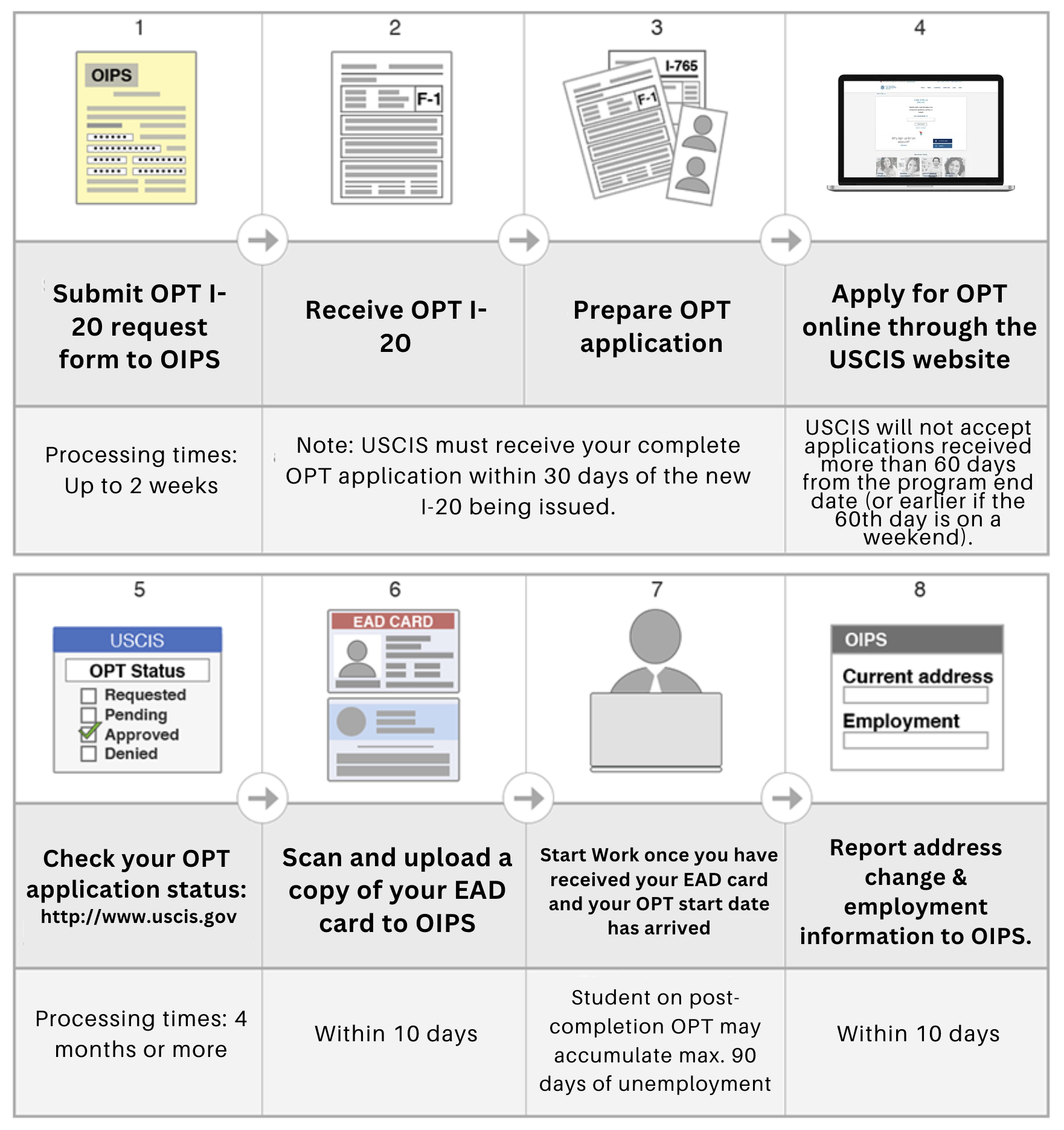
The OPT application process with USCIS can take up to four months. OIPS recommends that you start the OPT application process early to make sure you do not miss any important deadlines. The image below depicts the key OPT application steps and processing times. Please take a moment to review the steps and processing times/comments.

*You will need to request and complete the OPT workshop before you can request the OPT I-20*
Fees

The current fee is $470. This fee is always subject to change. Please see this page from the DHS website to confirm the current fee before you submit your application to USCIS.: Department of Homeland Security

Thesis/Dissertation Students

Thesis/Dissertation students, unlike other students, do not have to wait until they finish their degree to go on Post-completion OPT. Refer to the chart below to learn your options for starting Post-Completion OPT.

*Please note that every Thesis student’s situation is unique so it’s best to speak to an international advisor about Post-completion OPT*

The Thesis Student Timeline for Post-Completion OPT

Stage 1 Thesis student completes instructional coursework requirements (Pre full-time 998 coursework) Thesis Students become eligible for Post-Completion OPT after their last day of coursework. The earliest program end date thesis students can choose is their last day of coursework.
Stage 2 Student Completes 998, defends proposal, takes 999, works on dissertation, and readies for dissertation defense Students can apply for Post-Completion OPT during this stage and can choose any start date. Note: Student’s program end date will be adjusted based on selected start date.
Stage 3 Student defends dissertation Thesis students’ program end date is based around their defense date and must be no later than the last day of the semester in which they defend. Students must have work to do on their thesis up until that date in order to use it as their program end date.
Stage 4 Student completes work on Dissertation Thesis students’ latest possible end date is the last day they work on their thesis in the semester in which they defend. This is usually the last day of exams listed in the university calendar.

Important Reminders

  • Degree requirement completion dates are determined by the student and their primary academic advisor.
  • Processing times are lengthy, and thesis students still must plan ahead even though they can pick their own dates. Depending on processing times, USCIS may adjust chosen dates.
  • On-campus work authorization still ends on the I-20 program end date even if university contracts have later dates.
  • Thesis students who choose to go on Post-Completion OPT before they finish their degree have until the last day of their OPT period to complete all degree requirements.
  • Thesis students can take 998 and 999 while they are on OPT, but they cannot take coursework toward another degree.
  • Thesis students are also eligible for Pre-Completion OPT during stage 1 and 2. The Pre-Completion OPT would need to be part-time and half of the amount used will be subtracted from the length of the Post-Completion OPT period later on. Pre-Completion OPT could extend until the program end date.

Use this calculator to learn your Post-Completion OPT submission range:

When to Apply Calculator

Begin by entering the date that you will complete your program of study. Then click "Calculate Submission Range."

1st day to apply
Completion date
Deadline

Biometric Appointment Notice

Most students who apply for Post-Completion OPT will receive a request to appear for biometrics, which may include fingerprinting and biometric scanning. If you get an appointment for biometrics, you may be able to move your appointment time and location. If you can’t make your appointment time, reschedule your appointment in advance by at least 12 hours. Rescheduling within 12 hours or missing your appointment may lead to denial of your OPT application. If you have missed your appointment, you can attempt to call USCIS or use their online rescheduling tool through their chat assistant, Emma on the USCIS page. Learn more about biometrics appointments here: Preparing for Your Biometric Services Appointment | USCIS 

Choosing a Start Date for your OPT Period

Although OIPS cannot recommend a specific start date to students, you can use the following guidance to help you pick a start date for your OPT period.
  1. Connect with the career center. The career center can help you determine the average length of time it takes to get a job in your field which can help you determine if you will need more or less time to apply for positions.
  2. Ask your Supervisor. If you have already acquired a position in your field at the time of your OPT application, you may wish to see if your supervisor has a preferred start date.
  3. Talk to your professors. Some fields have hiring seasons, which would affect when you interview for positions and are hired. If you have a hiring season, your professors or the career center will be familiar with it.
Latest Possible day? Many students want to choose the latest possible day they can as a start date, so they can have more time to apply for jobs. This is not always the ideal option. If you get a job earlier than the last day, you will still have to wait for the late start date to arrive before you can begin working. Some employers will not hire employees who cannot start working soon after they are offered the role.

Use these calculators to check your range of possible start dates:

Choosing Your Start Date

The earliest start date you can request is the day after you complete all requirements for your program of study. The latest start date you can request is 60 days after you complete all your requirements.

Completion date
Earliest OPT start
Latest OPT start

Start Date Feasibility Calculator

Enter your program end date and desired OPT start date to see when you need to apply and whether your timeline is feasible. Processing times are only estimates and vary year to year.

Submission of Application to USCIS

The student is responsible for submission of their OPT application to USCIS in a complete and timely manner. While OIPS advisors will work with the student to give them the information to do this, the student is ultimately responsible for their OPT application to USCIS. To help, OIPS has made a video on the application to USCIS, which is available on our "Building the OPT Application" page here. Students who have an OPT I-20 that is approaching the 30 day point, and have not been submitted with the application to USCIS, must complete the Renewal of OPT/STEM OPT Recommendation, which can be found on the F-1 and J-1 forms page. The DSO recommendation in SEVIS is only good for 30 days, so a new recommendation in SEVIS will need to be done by a DSO. A DSO cannot put in a new recommendation for OPT after the grace period has passed.

Receiving the Employment Authorization Document (EAD) Card

Tracking the Arrival of your EAD card
 

For students who want to keep track of when their EAD card has been shipped, what address it will be sent to, and potentially what day the card is expected to arrive can sign up for the Informed Delivery Service with the US postal service. Students who have updated their address while their application is pending can use this to see if their card is going to be sent to an old address. You cannot use this service to change the address your card is sent to.

Replace a Lost or Stolen or Damaged EAD card
 

If you need an EAD card for reasons including it was stolen or lost then you will need to complete a new Form I-765 and pay the fee again. You may file online for your replacement card. You will indicate on the I-765 that your application is for the “Replacement of a lost, stolen, or damaged EAD, or correction of your EAD not due to USCIS error. Fill out the rest of the I-765 according to the instructions.

Replace an EAD card that was not delivered
 

If your card was not delivered by USCIS, you may need to make a request for another card using the I-765 form. You may also be able to inquire into your missing card using USCIS’s Non-Delivery of card form.

You can learn more about your options based on your specific situation at the following links:

Non-Delivery of Card form

I-765 Instructions

*To avoid having to replace a non-delivered card, please make sure to put in an accurate address on your I-765 form. If you plan to move or think you might move within the first months of graduating, you may wish to set-up a P.O Box or send your EAD card to a person you trust who can accept the mail on your behalf.

EAD cards with OPT end dates that exceed 14 months from the program end date
 

  • Generally speaking, Post-Completion OPT periods are one year long
  • The authorization period starts during the 60-day grace period and go up to 14 months after the program end date
  • If the program end date on your EAD card is after 14 months from your program end date, you may wish to update it as it can impact future immigration benefits.
  • See this page for more information

Maintaining status while on Post-Completion OPT

  • Once you are on OPT, you will have different requirements for maintaining your status than when you were a full-time student. Here is a summary of the rules:
    • Rather than maintain a full-course load of study, you will need to work full-time, which is 20 hours for immigration purposes (Your employer may define part-time and full-time work differently). Students only have 90 days of unemployment while on OPT.
    • You will not be required to have health insurance while you are on OPT, but it is highly recommended. Many employers offer health insurance. George Mason also offers health insurance through its alumni association, which you can learn about here.
    • You must work in a position that is directly related to your major area of study.
    • You must report your employment with 10 days of starting or changing employment.
    • You must report substantial changes in your employment. For a full list of what you need to report, see this page: OPT/STEM OPT Employment Update Form - Office of International Programs and Services
    • You will need to report your US Address within 10 days of your move to the employment update form and to the University via patriot web.
    • You are not allowed to be admitted and start taking classes toward another degree. For example, if you finished your Bachelor’s degree and you are on OPT, you cannot, at the same time, get admitted to a Master’s degree and start taking Maser’s level coursework. If you want to start another degree, you will need to end your OPT. Recreational and professional non-degree classes are allowed. Please speak with an OIPS International Advisor if you have questions about potential course enrollment.
    • You can work in a paid or unpaid position
    • You can work for multiple employers for a total of 20 or more hours between employers
    • There is no upper limit to the number of hours you can work, but your employer may have a limit.